Bedroom Furniture
How Tall Should a Bed Be? Frame Height, Mattress Depth and Knee Height
The bed fits you when the mattress top lands near knee height. Standard frame and mattress measurements, how they stack, and why under-bed clearance changes the answer.
By Ruth Alder · ·
If your feet dangle, or your knees ride above your hips as you push off to stand, the bed is the wrong height — no topper or mattress upgrade will fix it. Height is the one bed measurement nobody checks before buying and everybody notices the first morning. It is also the easiest part of the bed as a system to get right: simple arithmetic, three numbers you can verify before the truck arrives.
The number that decides it
Knee height. Sit on a chair and measure from the floor to the top of your kneecap — for most adults that lands between 16 and 22 inches. When the mattress top sits within an inch or two of that number, standing up costs the knees and hips almost nothing and sitting down is a controlled descent, not a drop. Couples should aim between the two knee heights, slightly favoring whoever has the stiffer joints in the morning.
The edge test confirms it before any purchase: sit on the mattress corner in the store or at delivery, feet flat. If your hips sit above your knees, the bed is tall for you; if your knees climb above your hips to rise, it is short. Ten seconds in that position tells you more than every display of frame finishes on the showroom floor.
How the stack adds up
Total bed height is three numbers: frame deck height, plus foundation if there is one, plus mattress depth.
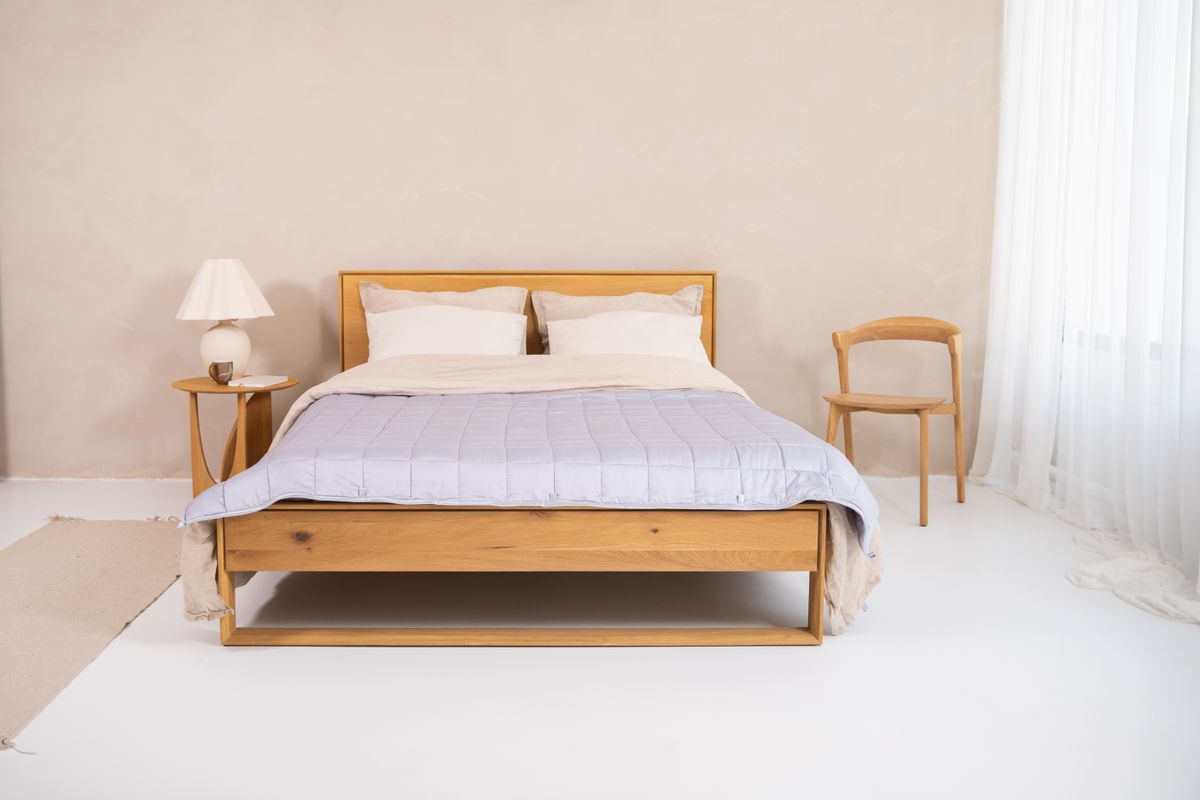
- Low platform frames sit their deck 8 to 12 inches off the floor. Add a 12-inch mattress and the bed lands at 20 to 24 inches — inside the comfortable band with no foundation at all. Platform frames and thick modern mattresses were made for each other; our platform frame picks list deck heights for that reason.
- Traditional frames built for a box spring sit higher, 12 to 14 inches at the rails. Add a 9-inch box spring and a 12-inch mattress and the total pushes 30 inches or more — fine for tall sleepers, a climb for everyone else. A low-profile 5-inch foundation is the standard fix.
- Mattress depth is doing more of the work every year. Modern mattresses run 10 to 14 inches thick, where older ones ran 8 to 9. A mattress bought for height has no business also being the thickest in the store; the number is always printed on the spec sheet.
Notice what the arithmetic implies: the same mattress can land inside or well outside the comfortable band depending on the foundation under it. Buyers who measured only the frame — or only the mattress — are the ones shopping for a step stool a month later.
Under-bed clearance changes the answer
The space below the deck is either dead air or the cheapest storage in the house. Under-bed bins run 6 to 8 inches tall; drawers built into frames need 10 to 12. If storage is the plan, the frame needs 12 inches of clearance minimum, floor to lowest slat or crossbar — a requirement that can settle the frame choice on its own. Our under-bed storage guide matches bin sizes to the clearance they need; the small bedroom layout rules treat under-bed space as part of the room’s floor plan.
Storage and comfort pull in the same direction here more often than not: the frames with 12 inches of clearance under the deck tend to land the mattress top in the 20-to-26-inch band that most adults want anyway. A frame chosen for bins is rarely wrong for knees.
Two cases that bend the rule
Older sleepers and anyone with joint pain do better higher, not lower. A bed top at 23 to 26 inches lets them rise by leaning forward rather than pushing up — the difference between independence and needing a hand. If a parent is moving in, measure their knee height and buy the frame for them, not the room.
Low beds for style work fine for people who hop up easily. The 14-to-16-inch platform look photographs well and reads calm in a small room. Just accept the trade honestly: guests and older relatives will find it harder to get out of than any bed they own.
Fixing a bed that is already the wrong height
Too tall is the easier direction. Swap a 9-inch box spring for a low-profile 5-inch foundation and the stack drops 4 inches without touching the frame, and the next mattress can be chosen with depth in mind — the spec sheet prints that number too. Most complaints that a bed runs too high turn out to be a foundation too tall for a modern thick mattress — a parts problem, not a furniture problem.
Too low is harder. A topper mostly changes feel and adds an inch at best; the honest fixes are a taller foundation or a different frame. Deck height should be published on any frame’s spec sheet, and ours is — if a seller cannot state the deck height, that omission is itself an answer about the rest of their specs. The one exception where low beds earn a pass is the guest room, used a few nights a year by people who arrive capable and leave before the knees vote.
Whichever direction the fix runs, re-run the stack arithmetic afterward with the new parts. A foundation swap that drops the bed 4 inches can also close the under-bed clearance a storage plan was counting on, so measure floor to lowest slat again before the old foundation leaves the house. Height and storage trade against each other at the same frame; the numbers decide, not the look.
Checking before you buy
Two numbers off the spec sheet, one off your body: frame deck height, mattress depth, and your knee height — add the first two, compare to the third. Everything else about a frame is taste and joinery; this one number is ergonomics, and the bed gets more hours of use than any other piece in the house.
Layer recap
Specs first, owners second. Check the layer you are about to buy against the layers above and below it — most bad reviews are mismatches, not bad products.
- Foundation
- Slat spacing and center support decide whether the mattress above keeps its shape. Read the foundation guide
- Support
- Firmness is a 1–10 scale, not a feeling — read it by weight and sleep position. Read the support guide
- Comfort
- A topper fixes one specific problem. Anything over 2 in only changes surface feel. Read the comfort guide
- Warmth
- Fill power means nothing without fill weight beside it. Read the warmth guide
- Surface
- Weave, staple length and GSM — then read the wash count, not the thread count. Read the surface guide
- Finish
- Loft has to match sleep position, and it has to come back overnight. Read the finish guide
Bed Layers, Decoded puts all six layers on one page — the numbers worth checking, the marketing traps, and how to read owner feedback before you order.
FAQ
What is a comfortable bed height for most adults? +
Sitting on the edge, your feet should rest flat on the floor and your knees should bend at roughly 90 degrees. For most adults that puts the mattress top between 20 and 25 inches from the floor. Measure your own knee height, from floor to the top of the kneecap while seated, and aim within an inch or two of it.
Is a low platform bed bad for you? +
Not inherently — a bed at 15 inches from floor to mattress top works fine for anyone who gets up and down easily. The effort shows up for people with knee, hip, or back issues, for whom standing up from a low bed multiplies the load on the joints. For those sleepers, bed height is an accessibility question first and a style question second.
How much under-bed clearance do I need for storage? +
A standard under-bed storage bin runs 6 to 8 inches tall, so you want at least 8 inches of clearance, and 12 inches opens up the deeper bins and drawers. Measure from the floor to the lowest part of the frame — slats or a crossbar, not the frame rail — before buying storage that assumes space the frame does not have.