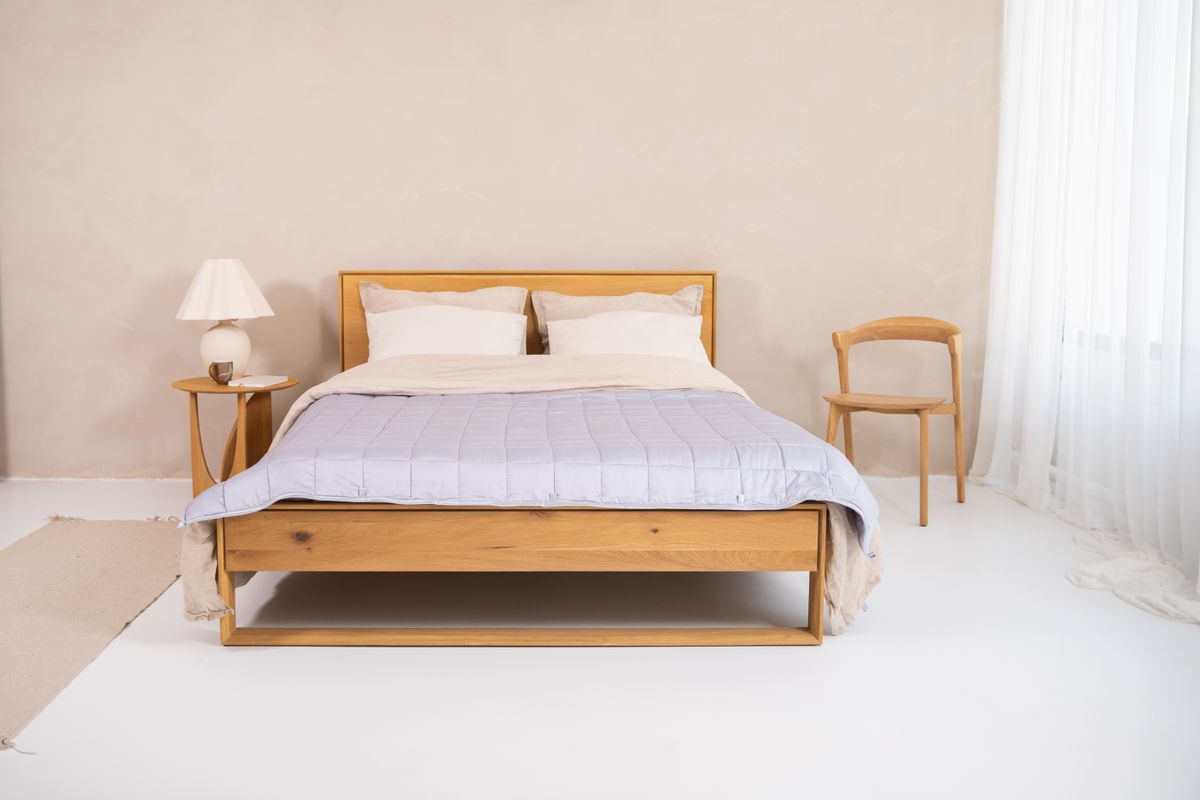
Bedroom Furniture
Wood or Metal Bed Frame: Where Each One Creaks First
Both materials hold a mattress fine. The difference shows up in the joints, the weight rating, and the winter your house dries out. How to read a frame's build before it starts talking.
By Ruth Alder · ·
Pick any two well-made bed frames and the material tells you less than the build does. Wood and steel both hold a mattress fine — the slat rules apply identically to either — so the useful question is which joint gives up first, and what the frame sounds like on the way down. Every frame creaks eventually. Build quality decides when, and build quality leaves signs you can check in ten minutes.
What wood does when the heat comes on
Wood moves with humidity. When the heating season dries the air, rails shrink a fraction of an inch, bolted joints loosen against the smaller rail, and the frame announces every turnover at 3 a.m. That is maintenance, not failure. An annual pass with a wrench keeps most wooden frames quiet for decades, and the owners who complain loudest about creaking wood are usually the ones who never re-tightened a bolt. The seasonal pattern doubles as a diagnostic: a frame that talks only in February has dry-air joints, while a frame that talks in July has a loose bolt or a cracked part instead.
Species decide how much trouble you get. Kiln-dried hardwood — oak, ash, walnut — holds joinery for the life of the frame. Pine is softer, dents under slippers, and can warp in a humid room, which is why budget pine frames ship with a center rail and six legs: the wood needs the help. Press a showroom rail with your palm. Hardwood feels like a table; pine feels like a shelf that might flex.
Joints: where wooden frames actually fail
Joinery matters more than species. Corner blocks, metal brackets, or mortise-and-tenon connections at the rail-to-post joints are the marks of a frame built to stay tight. A frame held only by bolts through raw wood chews its bolt holes loose over the years, and no amount of tightening fixes an oversize hole. If a showroom sample wobbles in month one, the one delivered to your door will wobble worse, because shipping punishes weak joints first.
The same check applies to used frames. A wobble from a loose bolt is a repair; a wobble from a worn hole is a replacement. Thirty seconds of pressure on the corner of a secondhand frame tells you which one you are looking at, and that is usually the difference between a bargain and a problem.
What steel does, and why gauge matters
Steel does not shrink, so a quality welded frame stays quiet indefinitely — the creak risk lives in bolted joints and feet, both cheap to fix. The number to read is gauge. Fourteen to 16 gauge steel is furniture grade; the thin stamped rails on budget frames flex under a dense mattress and crack at the bend points. If a listing does not state gauge or a weight rating, the price already told you what the answer is.
Metal fails politely, which is its best feature. Noise at contact points — a mattress sliding on a bare deck, legs tapping the floor — costs a few dollars to fix with felt pads and a rubber slat cap. Check the cross members under a platform deck too: they should be steel tubes, not flat straps you can twist by hand. And glance at the feet, where coatings chip first; bare steel in a damp room pits over time, so a basement apartment argues for a coated or painted frame.
Weight ratings tell the truth
Ignore the material and read the rating. Cheap frames of either species cluster around 400 to 500 pounds of total load — mattress plus sleepers. Well-built frames rate 800 to 1,000 pounds or higher, and reputable brands print the number on the spec sheet or carton. The rating matters more than it looks: a latex mattress alone can weigh 100 pounds, so a couple on a heavy mattress spends half of a cheap frame’s budget before anyone lies down. The same math applies to the foundation decision, which carries whatever the frame carries.
Ratings also expose contradiction. A frame advertised at 1,000 pounds but built with three skinny slats is disagreeing with itself, because the slats carry the mattress between the rails. Rating and slat count should tell the same story, and when they do not, believe the slats. Ask for the rating in writing whenever it is not printed; a brand that refuses to state one has stated something anyway.
When tightening stops working
Re-tightening every bolt each autumn is the entire maintenance routine for a wooden frame, and it takes five minutes with the assembly wrench. If a creak survives a full pass, locate it before blaming the frame: press on each corner in turn, then across the middle, until the sound repeats. A joint that still moves after tightening can take a rub of candle wax or a dry lubricant on its mating surfaces. A creak that survives both steps usually means cracked wood at a stress point. That is a structural problem rather than a maintenance one, and the frame has told you it is finished.
The upholstered asterisk
An upholstered frame is a wood or metal frame wearing foam and fabric, so the inspection does not change — it hides. Ask what the internal frame is and how the slats are spaced. Run a hand along the back of the headboard for solid structure rather than cardboard-backed panels; a soft headboard over an empty frame will dimple under your palm. On any secondhand upholstered piece, check the fabric seams for bed bug signs before it crosses the threshold. The secondhand bedroom checklist walks through that inspection step by step.
The ten-minute showroom check
Bring the whole list to the floor. Press the side rail for rigidity. Count the slats and hold their spacing against the standard rules. Run a hand along the joints feeling for brackets or blocks. Lift a corner to judge the weight, and ask for the weight rating whenever it is not printed. A frame that passes all five checks will be quiet regardless of what it is made of — which is how our platform frame picks are sorted, joinery and support first, finish second. Material is the least of what makes a frame quiet.
Layer recap
Specs first, owners second. Check the layer you are about to buy against the layers above and below it — most bad reviews are mismatches, not bad products.
- Foundation
- Slat spacing and center support decide whether the mattress above keeps its shape. Read the foundation guide
- Support
- Firmness is a 1–10 scale, not a feeling — read it by weight and sleep position. Read the support guide
- Comfort
- A topper fixes one specific problem. Anything over 2 in only changes surface feel. Read the comfort guide
- Warmth
- Fill power means nothing without fill weight beside it. Read the warmth guide
- Surface
- Weave, staple length and GSM — then read the wash count, not the thread count. Read the surface guide
- Finish
- Loft has to match sleep position, and it has to come back overnight. Read the finish guide
Bed Layers, Decoded puts all six layers on one page — the numbers worth checking, the marketing traps, and how to read owner feedback before you order.
FAQ
Do metal bed frames damage mattresses? +
No. The mattress never knows what the frame is made of — it only cares about slat spacing and surface rigidity. A metal frame with slats under 3 inches apart supports a foam mattress exactly as well as a wooden one. The one metal-frame failure mode is a deck of widely spaced wires or rails, which fails the same foam-support rule as wide wooden slats.
Why does my wooden bed frame creak, and how do I stop it? +
Wood shrinks in dry winter air and the bolted joints loosen against the smaller rail. Re-tightening every bolt usually silences it; if a joint still moves, rub candle wax or a dry lubricant on the mating surfaces. Creaks that survive both steps are usually cracked wood at a stress point, which is a structural problem, not a maintenance one.
Which frame holds more weight? +
Steel generally, but the spec sheet matters more than the material. Cheap frames of both materials rate 400 to 500 pounds, while well-built frames — heavy-gauge steel or kiln-dried hardwood with thick slats — rate 800 to 1,000 pounds or more. Check the published weight rating and the slat thickness before trusting either.