Organization
Linen Closet Organization: Zones, Folding and a Supply List
A linen closet works by zone and fold, not by cramming. Here is a three-zone layout for sheets and towels, the filing fold that stops shelf avalanches, and what belongs in each shelf.
By Ruth Alder · ·
A linen closet only stays organized if each shelf has a single job and every set is folded so it can be pulled one-handed. Three zones do that: sheets, towels, and supplies. The folding method matters more than the containers — the filing fold below is what keeps shelves from avalanching into a pile.
Zone 1: sheets, filed upright
Fold each sheet set, tuck it into one of its own pillowcases, and store it standing upright like a file folder rather than stacked flat. Two things improve immediately: pulling the bottom set no longer topples the stack, and you can see every set’s color and size at a glance. Label each bundle by bed size if the household has more than two mattresses.
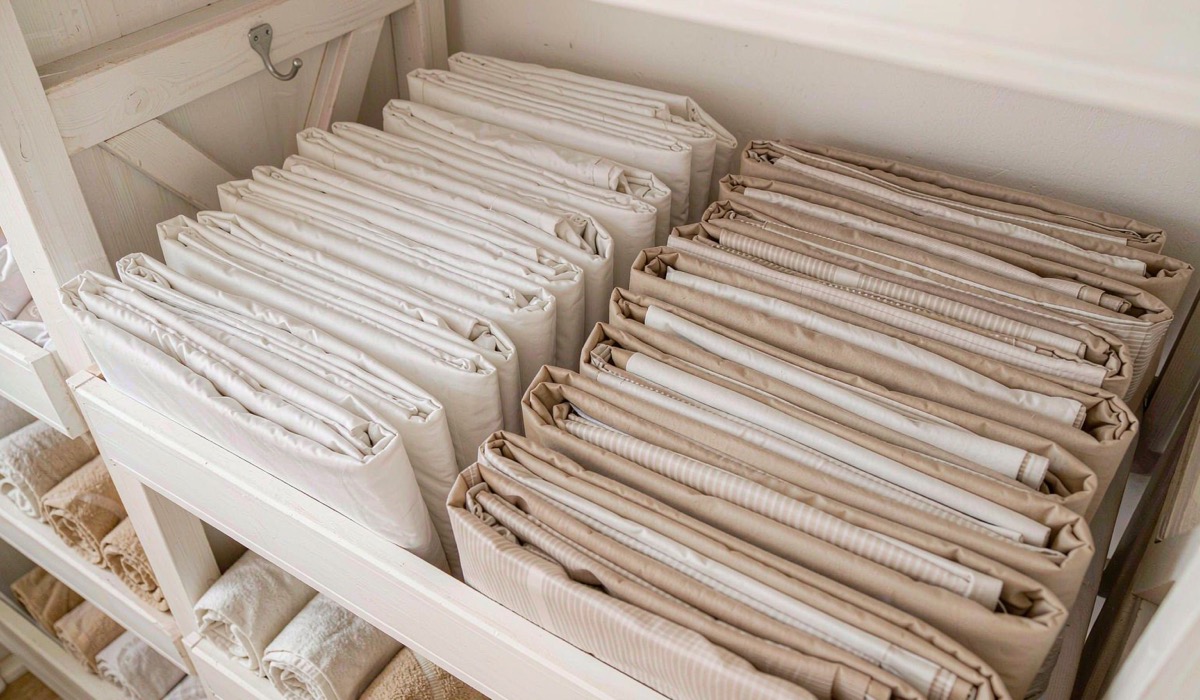
Filed upright like folders, each set pulls out one-handed.
Cull while you fold. Two to three sets per bed is the working number — one on the bed, one in the wash, one spare. Sets you skip for a full season go to donation or become cleaning rags. The washing rhythm for what stays is covered in our bedding washing guide.
Zone 2: towels, one method per shelf
Pick rolling or flat folding per shelf, not both. Rolled towels save roughly 20 to 30 percent of shelf depth and stay visible from the side, which suits deep or high shelves. Flat stacks suit deep inventories of matching towels. Order within the shelf by size — bath, hand, washcloth top to bottom — so nobody excavates for a washcloth.
Towel lifespan is finite: once a towel turns stiff or gray no amount of refolding helps. Our bath towel buying guide explains the GSM and cotton factors behind why some towels age well and others never soften.
Zone 3: supplies on the lowest shelf
The lowest shelf takes the heavy, unglamorous stock: extra toilet paper, cleaning supplies, replacement toothbrushes, light bulbs. Heavy items low keeps the closet stable and keeps the eye-level shelves for things you touch daily. Use matching bins with a label on the spine — open baskets of loose supplies are how linen closets regress.
The very top shelf is for rare-use overflow: guest bedding, luggage, holiday items, in sealed bins. If the top shelf is reachable only with a stool, it should not hold anything you need monthly.
Measure the shelves before buying anything
Shelf depth decides the folding, not the other way around. A deep shelf swallows a flat towel stack and leaves dead space behind it, and dead space is where spare sets go to be forgotten. Measure clear depth and height before buying any container: a bin that eats two inches of clearance turns every pull into a two-handed excavation.
Vertical shelf dividers solve most deep-shelf problems on their own — they split one deep shelf into two shallow columns, which is exactly what file-folded sheet sets want. A shallow closet forces flat stacks, and flat stacks are what avalanche; deep shelves are where the file fold earns its keep. Clear bins beat opaque ones in the supply zone, because you can see the stock level without pulling anything out. And leave one shelf part empty: a system with zero slack breaks the first week a guest duvet needs a home, and open shelf space is what absorbs the seasonal drift without another reorganization.
A closet near the bathroom needs airflow
Many linen closets share a wall with the bathroom, and that wall carries humidity. Towels folded slightly damp, or a closet that never gets opened, will grow a musty smell on the shelf itself — and no folding system fixes a shelf that smells. Everything goes on the shelf fully dry, and each stack keeps a hand’s width of space behind it instead of pressing against the back wall; on steamy days, leave the closet door open for an hour.
Store linens that are in weekly rotation in breathable cotton bags or open-weave bins rather than sealed plastic — residual moisture needs somewhere to go, which is the same rule the laundry follows: dry it first, then let it breathe.
If the closet is small or missing
The same rules run anywhere a shelf exists. A small closet still sorts into three zones — let the zones shrink instead of skipping them: sheets on top where they get touched least, towels at arm height, supplies low. Our small closet organization guide runs the tight-space version in detail.
With no linen closet at all, the file-fold method moves to a dresser or a shelf unit; a set stored inside its own pillowcase stacks exactly as well flat as it stands upright. Under-bed storage takes the spare sets and the seasonal duvet, and the supply zone splits between the bathroom vanity and wherever cleaning stock already lives. What matters is that each location keeps a single job — a drawer that mixes sheets with beach towels is a junk drawer with better manners.
What stays out of the linen closet
Least-used is not the same as never-used, but the two get confused on crowded shelves. The closet earns its space by holding what the household touches in a normal month: active sheet sets, towels in rotation, paper and soap stock. Off-season bedding is better off in a breathable bag under the bed than on a stool-only shelf.
Anything being saved for a house that does not exist yet — the dozen spare hand towels, the guest sets for visits that never happen — is inventory rather than storage, and it is the first thing to rehome. Donating the surplus is what makes the zones hold: a closet stays organized only when the total volume fits the shelves with room to spare.
The 20-minute reset
Twice a year, pull everything out and wipe the shelves down, then refold using the rules above. Do it on a laundry day, so the active sets are already in circulation and nothing has to balance dirty on the bed. The reset takes about 20 minutes for a standard hall closet and is the only maintenance the system needs; it is also what makes drift visible, because the things that wandered in since last time have nowhere to hide once the shelves are bare. Anything that does not fit back in a zone — the extra duvet, the fourth sheet set — is a signal, not a storage problem: it either replaces something or leaves. For the bedroom side of the same pass, our bedroom declutter checklist runs zone by zone.
Layer recap
Specs first, owners second. Check the layer you are about to buy against the layers above and below it — most bad reviews are mismatches, not bad products.
- Foundation
- Slat spacing and center support decide whether the mattress above keeps its shape. Read the foundation guide
- Support
- Firmness is a 1–10 scale, not a feeling — read it by weight and sleep position. Read the support guide
- Comfort
- A topper fixes one specific problem. Anything over 2 in only changes surface feel. Read the comfort guide
- Warmth
- Fill power means nothing without fill weight beside it. Read the warmth guide
- Surface
- Weave, staple length and GSM — then read the wash count, not the thread count. Read the surface guide
- Finish
- Loft has to match sleep position, and it has to come back overnight. Read the finish guide
Bed Layers, Decoded puts all six layers on one page — the numbers worth checking, the marketing traps, and how to read owner feedback before you order.
FAQ
How many sets of sheets should I keep? +
Two or three sets per bed: one on the bed, one in the wash, one spare. Anything beyond that rarely gets used and takes up the best shelf space in the closet. Extra sets are a common first cut when a linen closet overflows.
Should towels be rolled or folded in a linen closet? +
Rolled towels save roughly 20 to 30 percent of shelf depth and stay visible from the side, which works well on deep or high shelves. Folded towels stack tighter for large inventories. Choose one method per shelf — mixing both looks messy and wastes space.
How do I stop sheet sets from unfolding on the shelf? +
Store each set inside one of its own pillowcases, then file it upright like a folder. The pillowcase bundle keeps the set together, and the upright fold means pulling one set never collapses the stack behind it.